Lectern
Sign inSign in

Next: Lecture 1 of 6 · 1:14:36

Staff playlistEngineeringUndergraduate

From Circuits to Secure Systems: Electrical & Electronic Engineering

Electrical and electronic engineering at undergraduate level opens with Berkeley's ELENG 16A, then moves to op-amp compensation, CMOS logic and Verilog. Later steps reach Boyd on convex optimization and Jha on provable security for autonomous agents, both above undergraduate level. Runs from Kirchhoff's laws and op-amp compensation to Verilog, convex optimization and provable agent security.

6 lectures8 h5 institutions

Play

Lectures

6
1

Introduction to Circuit Elements and KCL/KVL

Bernhard Boser & Gireeja RanadeUC BerkeleyEECS 16A

Boser and Ranade set out circuit elements and Kirchhoff's current and voltage laws in ELENG 16A's first session.

1:14:36

1:14:36
2

Operational Amplifier Compensation Techniques

James K. RobergeMIT

Roberge tames a capacitively loaded LM101A with a bench-tested zero, then shapes a $1/\sqrt{s}$ roll-off.

57:01

57:01
3

Digital Design and Computer Architecture - L2: Combinational Logic

Onur MutluETH Zürich252-0028

Turning digital, Mutlu builds CMOS inverters and NAND gates up to ripple-carry and carry-lookahead adders.

1:48:07

1:48:07
4

Digital Design and Computer Architecture - L5: HDL, Verilog II, Timing & Verification

Onur MutluETH Zürich252-0028

In Verilog always blocks, Mutlu contrasts blocking and non-blocking assignments and how each maps onto flip-flops.

1:48:15

1:48:15
5

Mathematical Optimization & Why Convexity Is the Watershed

Stephen BoydStanford UniversityEE364a

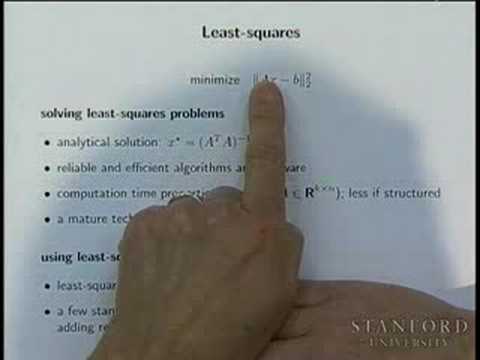
At graduate level, Boyd casts illumination power allocation as a convex problem that generalizes least squares.

1:20:33

1:20:33
6

Provable Privacy and Security for Autonomous Agents: Are We There Yet?

Somesh JhaUniversity of Wisconsin-Madison

Closing with research, Jha weighs how far formal methods can prove privacy and security for autonomous agents.

45:00

45:00

Companion reading for this sequence

2