Gilbert Strang
Professor of Mathematics Emeritus · MIT · Distinguished · author of Introduction to Linear Algebra
Gilbert Strang is Professor of Mathematics Emeritus at MIT and author of Introduction to Linear Algebra, the textbook behind his 18.06 course.
- lectures
- 66
- series
- 3
- hours
- 54
Start here


Series and courses
MIT 18.06: Linear Algebra
Open the course
- 1The Geometry of Linear Equations
- 2Elimination with Matrices
- 3Matrix Multiplication and Inverse Matrices
- 4Factorization into A = LU
Show 27 moreShow fewer
- 5Transposes, Permutations & Vector Spaces
- 6Column Space and Nullspace
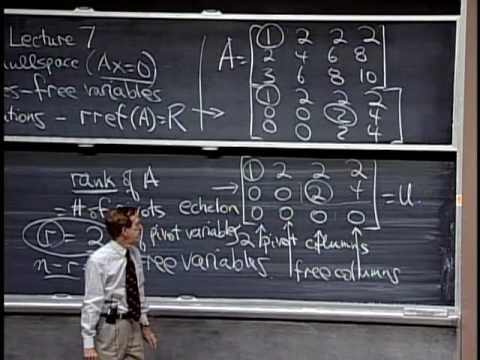
- 7Solving Ax = 0 — Pivot Variables, Free Variables & Rank
- 8Solving Ax = b — Complete Solutions & Full Rank Cases
- 9Independence, Basis, and Dimension
- 10The Four Fundamental Subspaces
- 11Matrix Spaces; Rank 1; Small World Graphs
- 12Graphs, Networks, Incidence Matrices
- 13Orthogonal Vectors and Subspaces
- 14Projections onto Subspaces
- 15Projection Matrices and Least Squares
- 16Orthogonal Matrices and Gram-Schmidt
- 17Properties of Determinants
- 18Determinant Formulas and Cofactors
- 19Cramer's Rule, Inverse Matrix, and Volume
- 20Eigenvalues and Eigenvectors
- 21Diagonalization and Powers of A
- 22Differential Equations and exp(At)
- 23Markov Matrices; Fourier Series
- 24Symmetric Matrices and Positive Definiteness
- 25Complex Matrices and the Fast Fourier Transform
- 26Positive Definite Matrices and Minima
- 27Similar Matrices and Jordan Form
- 28Singular Value Decomposition
- 29Linear Transformations and Their Matrices
- 30Change of Basis; Image Compression
- 31Left and Right Inverses; Pseudoinverse
MIT 18.065: Matrix Methods in Data Analysis, Signal Processing, and Machine Learning
Open the course
- 1The Column Space of A Contains All Vectors Ax
- 2Multiplying and Factoring Matrices
- 3Orthonormal Columns in Q Give Q'Q = I
- 4Eigenvalues and Eigenvectors
Show 27 moreShow fewer
- 5Positive Definite and Semidefinite Matrices
- 6Singular Value Decomposition (SVD)
- 7Eckart-Young: The Closest Rank k Matrix to A
- 8Norms of Vectors and Matrices
- 9Four Ways to Solve Least Squares Problems
- 10Survey of Difficulties with Ax = b
- 11Minimizing "x" Subject to Ax = b
- 12Computing Eigenvalues and Singular Values
- 13Randomized Matrix Multiplication
- 14Low Rank Changes in A and Its Inverse
- 15Matrices A(t) Depending on t, Derivative = dA/dt
- 16Derivatives of Inverse and Singular Values
- 18Counting Parameters in SVD, LU, QR, Saddle Points
- 19Saddle Points Continued, Maxmin Principle
- 20Definitions and Inequalities
- 21Minimizing a Function Step by Step
- 22Gradient Descent: Downhill to a Minimum
- 23Accelerating Gradient Descent: Momentum and Nesterov's Method
- 24Linear Programming and Two-Person Games
- 26Structure of Neural Networks for Deep Learning
- 27Backpropagation: Finding Partial Derivatives
- 28Completing a Rank-One Matrix and Circulants
- 29Eigenvectors of Circulant Matrices: Fourier Matrix
- 30ImageNet and Convolutional Neural Networks
- 31Neural Networks and the Learning Function
- 32Distance Matrices and the Procrustes Problem
- 33Finding Clusters in Graphs
In these lectures
- Elimination operations preserve the nullspace of a matrix while reducing it to echelon form.Solving Ax = 0 — Pivot Variables, Free Variables & Rank
- A vector space is closed under linear combinations.Column Space and Nullspace
- Matrix multiplication can be computed four ways: standard row-column dot products, columns of multiplying columns of , rows of multiplying rows of , and sums of rank-1 outer products.Matrix Multiplication and Inverse Matrices
Draws on
People cited in the lectures, at the moment of the citation.
- Professor RaoUniversity of Michigan, taught previous lectures and created online homeworks
- Raj RaoPrevious instructor of the course who used Julia.
- Carl Friedrich GaussCited as a historical figure in mathematics.
- Prof JohnsonReference on the board
- Professor TownsendCited as a specialist in the topic of section 4.3 and a former instructor of 18.06.
- Geoffrey HintonCo-author of the deep learning paper, described as one of the leaders in the field.
About
Gilbert Strang is Professor of Mathematics Emeritus at MIT and author of Introduction to Linear Algebra, the textbook behind his 18.06 course. His undergraduate lectures derive elimination, determinants, projections and eigenvalues in 18.06, then least squares, matrix norms and eigenvalue algorithms in 18.065.
Taught with
Same subject, Mathematics
Connections
77Their places, courses, books and lectures.
Scholar1
Institutions3
Courses3
Concepts2
Lectures66
- Solving Ax = 0 — Pivot Variables, Free Variables & Rank
- Column Space and Nullspace
- Matrix Multiplication and Inverse Matrices
- Independence, Basis, and Dimension
- Eigenvalues and Eigenvectors
- The Geometry of Linear Equations
Show 60 moreShow fewer
- Transposes, Permutations & Vector Spaces $\mathbb{R}^n$
- Eigenvalues and Eigenvectors
- Projections onto Subspaces
- Positive Definite and Semidefinite Matrices
- Determinant Formulas and Cofactors
- The Column Space of A Contains All Vectors Ax
- Graphs, Networks, Incidence Matrices
- Properties of Determinants
- Norms of Vectors and Matrices
- Orthogonal Matrices and Gram-Schmidt
- Computing Eigenvalues and Singular Values
- Orthogonal Vectors and Subspaces
- Singular Value Decomposition (SVD)
- Four Ways to Solve Least Squares Problems
- Matrix Spaces; Rank 1; Small World Graphs
- Matrices A(t) Depending on t, Derivative = dA/dt
- Factorization into A = LU
- Projection Matrices and Least Squares
- The Four Fundamental Subspaces
- Definitions and Inequalities
- Elimination with Matrices
- Cramer's Rule, Inverse Matrix, and Volume
- Minimizing "x" Subject to Ax = b
- Symmetric Matrices and Positive Definiteness
- Differential Equations and exp(At)
- Linear Transformations and Their Matrices
- Low Rank Changes in A and Its Inverse
- Complex Matrices and the Fast Fourier Transform
- Diagonalization and Powers of A
- Multiplying and Factoring Matrices
- Orthonormal Columns in Q Give Q'Q = I
- Survey of Difficulties with Ax = b
- Change of Basis; Image Compression
- Similar Matrices and Jordan Form
- Derivatives of Inverse and Singular Values
- Markov Matrices; Fourier Series
- Saddle Points Continued, Maxmin Principle
- Counting Parameters in SVD, LU, QR, Saddle Points
- Singular Value Decomposition
- Completing a Rank-One Matrix and Circulants
- Left and Right Inverses; Pseudoinverse
- Eckart-Young: The Closest Rank k Matrix to A
- Gradient Descent: Downhill to a Minimum
- Differentials and Antiderivatives
- Minimizing a Function Step by Step
- Eigenvectors of Circulant Matrices: Fourier Matrix
- Positive Definite Matrices and Minima
- ImageNet and Convolutional Neural Networks
- Solving Ax = b — Complete Solutions & Full Rank Cases
- Neural Networks and the Learning Function
- Accelerating Gradient Descent: Momentum and Nesterov's Method
- Finding Clusters in Graphs
- Randomized Matrix Multiplication
- Newton's Method and Other Applications
- Distance Matrices and the Procrustes Problem
- Linear Programming and Two-Person Games
- Structure of Neural Networks for Deep Learning
- Backpropagation: Finding Partial Derivatives
- Mean Value Theorem and Inequalities
- Related Rates