Opening Change of Basis; Image Compression
Change of Basis; Image Compression
- Length
- 50 min
- Level
- Undergraduate
- Recorded
- MIT2019
Opening Change of Basis; Image Compression
Chapter 1 of 6: Image compression and JPEG
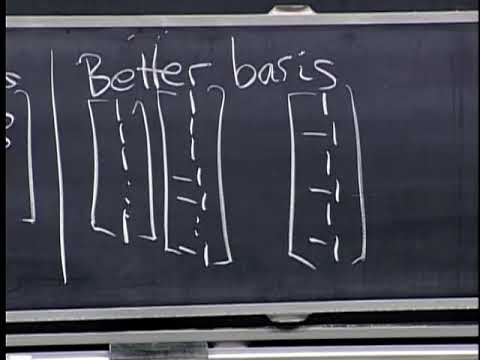
Strang compresses an image by switching pixels into a wavelet basis, then throwing away the small coefficients.
Change of basis in linear algebra becomes concrete in Strang's session 30 of MIT 18.06, where a better basis lets most of an image's coefficients be discarded. Strang treats a picture as a long vector of pixel values and shows why the standard basis ignores correlation between neighbouring pixels. Fourier bases, as in JPEG, and a wavelet basis built from scaled step functions concentrate the signal into few coefficients. Thresholding then zeroes the small ones, and orthonormal wavelets invert by transposition. The second half writes a basis change with and , proves that a transformation's matrices in two bases are similar, and reaches the diagonal matrix of an eigenvector basis.
Change of basis in linear algebra becomes concrete in Strang's session 30 of MIT 18.06, where a better basis lets most of an image's coefficients be discarded. Strang treats a picture as a long vector of pixel values and shows why the standard basis ignores correlation between neighbouring pixels. Fourier bases, as in JPEG, and a wavelet basis built from scaled step functions concentrate the signal into few coefficients. Thresholding then zeroes the small ones, and orthonormal wavelets invert by transposition. The second half writes a basis change with and , proves that a transformation's matrices in two bases are similar, and reaches the diagonal matrix of an eigenvector basis.
This lecture
Lecture 30 of 31 of Linear Algebra.
Choose a node to see how it connects to this lecture. What comes before is on the leftat the top. What comes after is on the rightat the bottom. The ring is what it teaches. People and places are above. Other lectures and books are below.
Press a chosen node again to open it.
Your comment is kept while you sign up.Sign in


