Opening Controllability and the PBH Test
Controllability and the PBH Test
- Length
- 14 min
- Level
- Undergraduate
- Recorded
- University of Washington2017
Opening Controllability and the PBH Test
Chapter 1 of 3: The PBH test definition
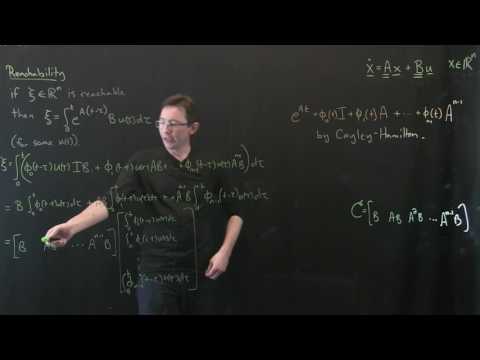
The Popov-Belevitch-Hautus (PBH) test decides whether a linear system is controllable by checking the rank of . Brunton shows that the rank can only drop at eigenvalues of , so the check reduces from the whole complex plane to a finite set. Controllability then requires to have a component along every eigenvector of , which a random actuation vector achieves with high probability. Repeated eigenvalues set the minimum number of independent control columns. Nearly degenerate eigenvalues leave a gray area where one input is technically enough but practically weak. Session 8 of the Control Bootcamp assumes matrix rank, eigenvalues and state-space models.
Your comment is kept while you sign up.Sign in
Brunton reduces the controllability check to the eigenvalues of and shows why a random almost always works.
The Popov-Belevitch-Hautus (PBH) test decides whether a linear system is controllable by checking the rank of . Brunton shows that the rank can only drop at eigenvalues of , so the check reduces from the whole complex plane to a finite set. Controllability then requires to have a component along every eigenvector of , which a random actuation vector achieves with high probability. Repeated eigenvalues set the minimum number of independent control columns. Nearly degenerate eigenvalues leave a gray area where one input is technically enough but practically weak. Session 8 of the Control Bootcamp assumes matrix rank, eigenvalues and state-space models.
This lecture
Lecture 8 of 28 of Control Bootcamp: Linear Systems & Optimal Control.
Choose a node to see how it connects to this lecture. What comes before is on the leftat the top. What comes after is on the rightat the bottom. The ring is what it teaches. People and places are above. Other lectures and books are below.
Press a chosen node again to open it.