Lecture 1.1: Introduction to Distributed Systems (CST-DS)
14:36Distributed Systems 1.3: RPC (Remote Procedure Call)
19:44Distributed Systems 2.3: System models
20:44Distributed Systems 3.1: Physical time
20:47Distributed Systems 3.2: Clock synchronisation
15:57Distributed Systems 3.3: Causality and happens-before
16:24Distributed Systems 4.1: Logical time
24:01Lecture 4.2: Broadcast Ordering (CST-DS)
16:19Lecture 5.1: Replication (CST-DS)
25:21Lecture 6.1: Consensus (CST-DS)
18:15Lecture 6.2: Raft (CST-DS)
38:09Lecture 7.1: Two-Phase Commit (CST-DS)
18:45Lecture 7.2: Linearizability (CST-DS)
18:44Lecture 7.3: Eventual Consistency (CST-DS)
14:59Lecture 8.1: Collaboration Software (CST-DS)
36:26Distributed Systems 3.2: Clock synchronisation

Associate Professor of Distributed Systems
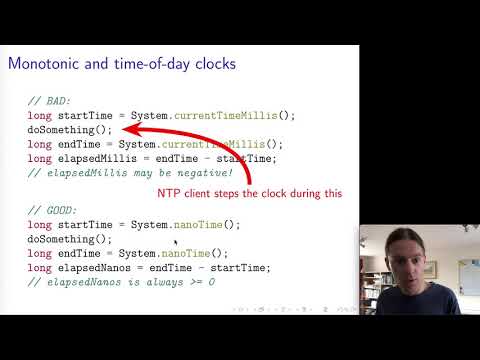
This lecture investigates the fundamental challenges of clock synchronization in distributed systems, contrasting physical clock synchronization protocols like NTP with logical clocks and vector clocks, and their implications for event ordering.
Accompanying lecture notes: https://www.cl.cam.ac.uk/teaching/2122/ConcDisSys/dist-sys-notes.pdf
Full lecture series: https://www.youtube.com/playlist?list=PLeKd45zvjcDFUEv_ohr_HdUFe97RItdiB
This video is part of an 8-lecture series on distributed systems, given as part of the undergraduate computer science course at the University of Cambridge. It is preceded by an 8-lecture course on concurrent systems for which videos are not publicly available, but slides can be found on the course web page: https://www.cl.cam.ac.uk/teaching/2122/ConcDisSys/materials.html
Distributed Systems 3.1: Physical time
Next · Lecture 6Distributed Systems 3.3: Causality and happens-before
Seminar notes & discussion
No public seminar notes on this lecture yet.