Opening Exploration of advanced topics in deep reinforcement learning
Exploration of advanced topics in deep reinforcement learning
- Length
- 24 min
- Level
- Graduate
- Recorded
- UC Berkeley2020
Opening Exploration of advanced topics in deep reinforcement learning
Chapter 1 of 2: Trajectory optimization with derivatives
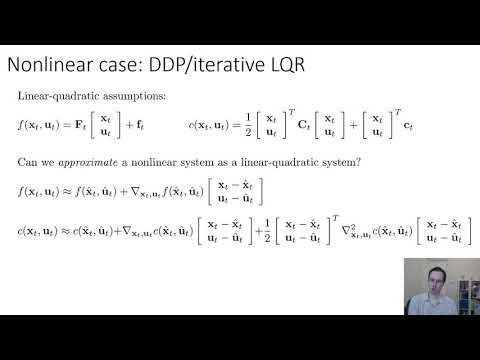
Trajectory optimization in deep reinforcement learning replaces black-box search with derivative-based methods when system dynamics are known. The lecture contrasts shooting methods, which optimize exclusively over action sequences, with collocation methods that constrain both states and actions. It then derives the Linear Quadratic Regulator algorithm, working through the base case at the final time step and using backward recursion to compute value functions and policy gains. The process concludes with a forward pass that determines the optimal state and control sequences from a known initial state.
Your comment is kept while you sign up.Sign in
Levine derives the Linear Quadratic Regulator by backward recursion from the final time step.
Trajectory optimization in deep reinforcement learning replaces black-box search with derivative-based methods when system dynamics are known. The lecture contrasts shooting methods, which optimize exclusively over action sequences, with collocation methods that constrain both states and actions. It then derives the Linear Quadratic Regulator algorithm, working through the base case at the final time step and using backward recursion to compute value functions and policy gains. The process concludes with a forward pass that determines the optimal state and control sequences from a known initial state.
This lecture
Lecture 30 of 73 of Deep Reinforcement Learning.
Choose a node to see how it connects to this lecture. What comes before is on the leftat the top. What comes after is on the rightat the bottom. The ring is what it teaches. People and places are above. Other lectures and books are below.
Press a chosen node again to open it.