Sergey Levine
Professor of Electrical Engineering and Computer Sciences · UC Berkeley · Distinguished
Sergey Levine is a Professor of Electrical Engineering and Computer Sciences at UC Berkeley who works on reinforcement learning and robotics and teaches CS 285.
- lectures
- 69
- series
- 1
- hours
- 23
Start here
- Imitation Learning II: Covariate Shift & Dataset Aggregation (DAgger)from Sutton & Barto, Reinforcement Learning: An Introduction

- Natural Policy Gradients, Covariant Updates & The Fisher Information Matrixfrom Sutton & Barto, Reinforcement Learning: An Introduction
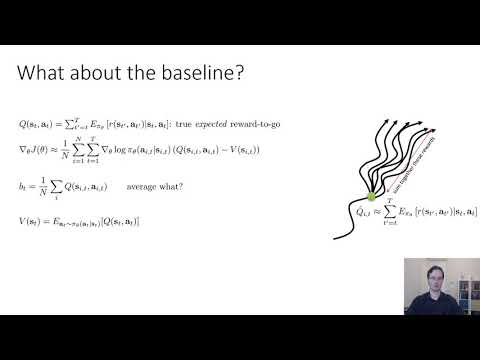
- Policy Gradients I: Deriving the REINFORCE Estimator & Policy Objectivefrom Sutton & Barto, Reinforcement Learning: An Introduction

Series and courses
UC Berkeley CS 285: Deep Reinforcement Learning
Open the course
- 1Foundations of Deep Reinforcement Learning: Problem Formulation & Neural Control
- 2Sequential Decision-Making: Policy Gradients vs. Value-Based Architectures
- 3Imitation Learning I: Behavioral Cloning & Distributional Shift
- 4Imitation Learning II: Covariate Shift & Dataset Aggregation (DAgger)
Show 65 moreShow fewer
- 5Imitation Learning III: Inverse RL & Generative Adversarial Imitation Learning (GAIL)
- 6Policy Gradient Foundations: Trajectory Distributions & High-Dimensional State Spaces
- 7Deep Reinforcement Learning
- 8Policy Gradients I: Deriving the REINFORCE Estimator & Policy Objective
- 9Exploration of fundamental concepts in deep reinforcement learning
- 10Policy Gradients II: Variance Reduction, Baselines & Reward-to-Go Causality
- 11Actor-Critic Methods: Value Function Bootstrapping & Advantage Estimation
- 12Exploration of deep reinforcement learning architectures and algorithms
- 13Natural Policy Gradients, Covariant Updates & The Fisher Information Matrix
- 14Trust Region Policy Optimization (TRPO) & Monotonic Policy Improvement
- 15Exploration of fundamental concepts in deep reinforcement learning
- 16Exploration of advanced topics in deep reinforcement learning
- 17Foundational concepts in deep reinforcement learning
- 18Exploration of fundamental concepts in deep reinforcement learning
- 19Exploration of deep reinforcement learning architectures and algorithms
- 20Foundational concepts in deep reinforcement learning, likely
- 21Exploration of deep reinforcement learning techniques
- 22Deep Reinforcement Learning
- 23Exploration of advanced topics in deep reinforcement learning
- 24Exploration of advanced topics in deep reinforcement learning
- 25Deep Reinforcement Learning
- 26Exploration of deep reinforcement learning, likely
- 27Exploration of advanced topics in deep reinforcement learning
- 28Foundational concepts in deep reinforcement learning
- 29Exploration of advanced topics in deep reinforcement learning
- 30Exploration of advanced topics in deep reinforcement learning
- 31Exploration of advanced topics in deep reinforcement learning
- 32Fundamental concepts in deep reinforcement learning
- 33Exploration of advanced topics in deep reinforcement learning
- 34Exploration of deep reinforcement learning algorithms
- 35Exploration of advanced topics in deep reinforcement learning
- 36Model-Based Reinforcement Learning with Policies
- 37Model-Based Reinforcement Learning with Policies
- 38Model-Based Reinforcement Learning with Policies
- 39Foundational concepts in deep reinforcement learning
- 40Exploration of advanced topics in deep reinforcement learning
- 41Exploration of advanced topics in deep reinforcement learning
- 42Deep Reinforcement Learning
- 43Exploration of advanced topics in deep reinforcement learning
- 44Exploration of advanced topics in deep reinforcement learning
- 45Offline Reinforcement Learning
- 46Offline Reinforcement Learning
- 47Offline Reinforcement Learning (CS 285, Lecture 15, Part 3)
- 48Offline Reinforcement Learning II
- 49Offline Reinforcement Learning II
- 50RL Theory
- 51RL Theory
- 52Variational Inference, Part 1 (CS 285, Lecture 18)
- 53Variational Inference, Part 2
- 54Variational Inference, Part 3
- 55Variational Inference, Part 4 (CS 285, Lecture 18)
- 56Control as Inference, Part 1
- 57Control as Inference, Part 2
- 58Control as Inference, Part 3
- 59Control as Inference, Part 5
- 60Inverse Reinforcement Learning, Part 1
- 61Inverse Reinforcement Learning, Part 2
- 62Inverse Reinforcement Learning, Part 4
- 65RL with Sequence Models & Language Models, Part 1 (CS 285, Lecture 21)
- 66RL with Sequence Models & Language Models, Part 2
- 67RL with Sequence Models & Language Models, Part 3
- 68Transfer Learning & Meta-Learning
- 69Transfer Learning & Meta-Learning (CS 285, Lecture 22, Part 5)
- 70Challenges and Open Problems in Deep Reinforcement Learning (CS 285, Lecture 23, Part 1)
- 71Challenges & Open Problems in Deep Reinforcement Learning
In these lectures
- Behavioral cloning suffers from covariate shift because training and test state distributions diverge.Imitation Learning II: Covariate Shift & Dataset Aggregation (DAgger)
- Policy gradients suffer from high variance because reward-to-go uses single-sample trajectory estimates.Natural Policy Gradients, Covariant Updates & The Fisher Information Matrix
- The reinforcement learning objective can be expressed as an expectation over a trajectory distribution.Policy Gradients I: Deriving the REINFORCE Estimator & Policy Objective
Draws on
People cited in the lectures, at the moment of the citation.
- Daniel WolpertNeuroscientist working on motor control, cited for his quote on brains and movement.
- Richard BellmanPioneer of Markov decision processes in the 1950s
- Bert KappenWork on KL-divergence control
- Richard SuttonPioneer of reinforcement learning in computer science.
- Yael NivPsychology Department & Princeton Neuroscience Institute, Princeton University, cited for reinforcement learning in the brain
- Alan TuringQuoted on simulating the child's mind versus the adult mind
About
Sergey Levine is a Professor of Electrical Engineering and Computer Sciences at UC Berkeley who works on reinforcement learning and robotics and teaches CS 285. His graduate lectures derive REINFORCE with baselines, analyse covariate shift and DAgger, and build actor-critic methods, TRPO and variational inference.
Taught with
Same subject, AI & Machine Learning
Connections
75Their places, courses, books and lectures.
Institutions3
Concept1
Lectures69
- Imitation Learning II: Covariate Shift & Dataset Aggregation (DAgger)
- Natural Policy Gradients, Covariant Updates & The Fisher Information Matrix
- Policy Gradients I: Deriving the REINFORCE Estimator & Policy Objective
- RL with Sequence Models & Language Models, Part 2
- Variational Inference, Part 2
- Policy Gradients II: Variance Reduction, Baselines & Reward-to-Go Causality
Show 63 moreShow fewer
- Sequential Decision-Making: Policy Gradients vs. Value-Based Architectures
- Policy Gradient Foundations: Trajectory Distributions & High-Dimensional State Spaces
- RL Theory
- Trust Region Policy Optimization (TRPO) & Monotonic Policy Improvement
- Challenges & Open Problems in Deep Reinforcement Learning
- Imitation Learning I: Behavioral Cloning & Distributional Shift
- Variational Inference, Part 1 (CS 285, Lecture 18)
- Exploration of advanced topics in deep reinforcement learning
- Variational Inference, Part 3
- Imitation Learning III: Inverse RL & Generative Adversarial Imitation Learning (GAIL)
- Deep Reinforcement Learning
- Actor-Critic Methods: Value Function Bootstrapping & Advantage Estimation
- Inverse Reinforcement Learning, Part 1
- Deep Reinforcement Learning
- Variational Inference, Part 4 (CS 285, Lecture 18)
- Foundations of Deep Reinforcement Learning: Problem Formulation & Neural Control
- RL with Sequence Models & Language Models, Part 1 (CS 285, Lecture 21)
- Deep Reinforcement Learning
- Inverse Reinforcement Learning, Part 4
- Fundamental concepts in deep reinforcement learning
- Inverse Reinforcement Learning, Part 2
- Exploration of fundamental concepts in deep reinforcement learning
- Offline Reinforcement Learning II
- Offline Reinforcement Learning
- Control as Inference, Part 2
- Exploration of fundamental concepts in deep reinforcement learning
- Control as Inference, Part 1
- Model-Based Reinforcement Learning with Policies
- RL with Sequence Models & Language Models, Part 3
- Control as Inference, Part 3
- Transfer Learning & Meta-Learning
- Offline Reinforcement Learning (CS 285, Lecture 15, Part 3)
- Foundational concepts in deep reinforcement learning
- Challenges and Open Problems in Deep Reinforcement Learning (CS 285, Lecture 23, Part 1)
- Foundational concepts in deep reinforcement learning
- Exploration of advanced topics in deep reinforcement learning
- Exploration of deep reinforcement learning, likely
- Deep Reinforcement Learning
- Exploration of advanced topics in deep reinforcement learning
- Model-Based Reinforcement Learning with Policies
- Model-Based Reinforcement Learning with Policies
- Exploration of advanced topics in deep reinforcement learning
- Exploration of advanced topics in deep reinforcement learning
- Foundational concepts in deep reinforcement learning
- Transfer Learning & Meta-Learning (CS 285, Lecture 22, Part 5)
- Exploration of deep reinforcement learning architectures and algorithms
- Offline Reinforcement Learning II
- Offline Reinforcement Learning
- Exploration of advanced topics in deep reinforcement learning
- RL Theory
- Control as Inference, Part 5
- Exploration of advanced topics in deep reinforcement learning
- Exploration of deep reinforcement learning algorithms
- Exploration of advanced topics in deep reinforcement learning
- Exploration of deep reinforcement learning architectures and algorithms
- Exploration of fundamental concepts in deep reinforcement learning
- Exploration of advanced topics in deep reinforcement learning
- Exploration of advanced topics in deep reinforcement learning
- Exploration of advanced topics in deep reinforcement learning
- Exploration of advanced topics in deep reinforcement learning
- Exploration of deep reinforcement learning techniques
- Foundational concepts in deep reinforcement learning, likely
- Exploration of advanced topics in deep reinforcement learning