Introduction and Proofs (MIT 6.042J, Lecture 1)
44:09Mathematical Induction (MIT 6.042J, Lecture 2)
1:19:25Strong Induction (MIT 6.042J, Lecture 3)
1:22:00Number Theory I (MIT 6.042J, Lecture 4)
1:20:24Number Theory II (MIT 6.042J, Lecture 5)
1:18:45Graph Theory and Coloring (MIT 6.042J Mathematics for Computer Science, Lecture 6)
1:22:51Matching Problems (MIT 6.042J Mathematics for Computer Science, Lecture 7)
1:22:40Graph Theory II: Minimum Spanning Trees (MIT 6.042J, Lecture 8)
1:23:26Lecture 9: Communication Networks (6.042J)
1:23:25Lecture 10: Graph Theory III (6.042J)
1:22:50Lecture 11: Relations, Partial Orders, and Scheduling (6.042J)
1:04:00Lecture 12: Sums (6.042J)
1:18:22Lecture 13: Sums and Asymptotics (6.042J)
1:23:40Divide and Conquer Recurrences (MIT 6.042J, Lecture 14)
1:22:46Lecture 15: Linear Recurrences (6.042J)
1:18:20Lecture 16: Counting Rules I (6.042J)
1:20:02Lecture 17: Counting Rules II (6.042J)
1:25:24Lecture 18: Probability Introduction (6.042J)
1:23:56Lecture 19: Conditional Probability (6.042J)
1:21:46Lecture 20: Independence (6.042J)
1:22:02Lecture 21: Random Variables (6.042J)
1:22:59Lecture 22: Expectation I (6.042J)
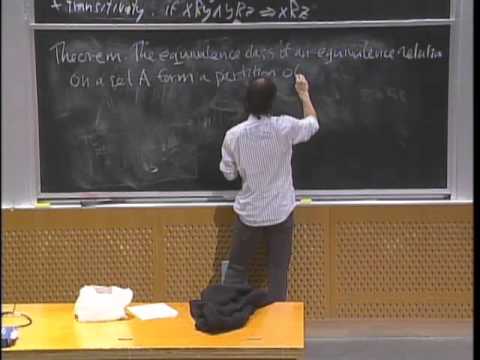
1:23:54Lecture 11: Relations, Partial Orders, and Scheduling (6.042J)

This lecture covers binary relations, focusing on properties of partial orders and their applications in scheduling problems, including topological sorting and critical path analysis.
Lecture 11: Relations, Partial Orders, and Scheduling
Instructor: Marten van Dijk
View the complete course: http://ocw.mit.edu/6-042JF10
More courses at http://ocw.mit.edu
Lecture 10: Graph Theory III (6.042J)
Next · Lecture 12Lecture 12: Sums (6.042J)