Opening Advanced Neurology and Endocrinology
Advanced Neurology and Endocrinology
- Length
- 1 h 13 min
- Level
- Undergraduate
- Recorded
- Stanford University2011
Opening Advanced Neurology and Endocrinology
Chapter 1 of 10: Overview of neurobiology and endocrinology
Sapolsky tests Dale's laws against co-released transmitters, Lettvin's branch-point blocks and axo-axonic synapses.
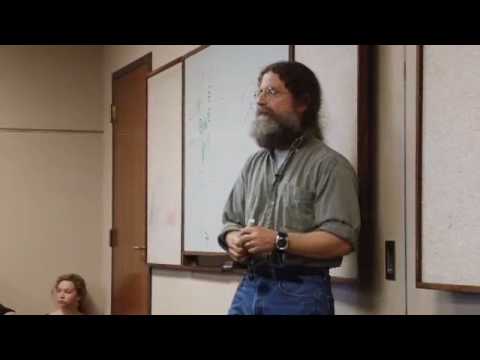
Dale's laws of neurobiology, which hold that a neuron releases one transmitter and signals identically down every branch, break down in real nervous systems. In session 13 of Stanford's BIO 150, recorded April 28, 2010, Sapolsky shows vesicles carrying several transmitters and Jerry Lettvin's branch-point blockades redirecting action potentials. He traces how multiple releasing factors produce distinct ACTH stress signatures and how pituitary cells act in local neighborhoods. Negative feedback, following Mary Dallman's models, can track absolute hormone levels or their rate of change. Receptor up- and downregulation, subunit composition, GABA receptors binding tranquilizers and progesterone derivatives, and axo-axonic neuromodulation follow, assuming basic neuron anatomy and the pituitary axes.
Dale's laws of neurobiology, which hold that a neuron releases one transmitter and signals identically down every branch, break down in real nervous systems. In session 13 of Stanford's BIO 150, recorded April 28, 2010, Sapolsky shows vesicles carrying several transmitters and Jerry Lettvin's branch-point blockades redirecting action potentials. He traces how multiple releasing factors produce distinct ACTH stress signatures and how pituitary cells act in local neighborhoods. Negative feedback, following Mary Dallman's models, can track absolute hormone levels or their rate of change. Receptor up- and downregulation, subunit composition, GABA receptors binding tranquilizers and progesterone derivatives, and axo-axonic neuromodulation follow, assuming basic neuron anatomy and the pituitary axes.
The Zebra's Book
Zebra chapter on depression

This lecture
Lecture 5 of 6 of Human Behavioral Biology.
Choose a node to see how it connects to this lecture. What comes before is on the leftat the top. What comes after is on the rightat the bottom. The ring is what it teaches. People and places are above. Other lectures and books are below.
Press a chosen node again to open it.
Your comment is kept while you sign up.Sign in