Opening Motivation for Full-State Estimation
Motivation for Full-State Estimation
- Length
- 11 min
- Level
- Undergraduate
- Recorded
- University of Washington2017
Opening Motivation for Full-State Estimation
Chapter 1 of 3: Review of full-state feedback and LQR
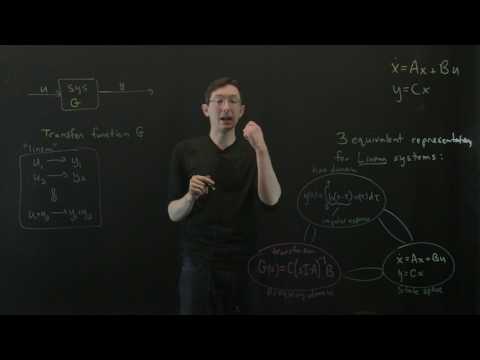
Full-state estimation reconstructs the state vector of a linear system when sensors measure only . Brunton opens with a review of full-state feedback and the linear quadratic regulator, both of which assume every state variable is known. Real systems offer only limited measurements, so he introduces observability as the dual of controllability. Observability decides whether the state can be backed out from outputs. He then sketches the architecture in which a Kalman filter takes inputs and measurements, estimates , and feeds that estimate to an LQR controller. Session 13 of the Control Bootcamp follows Chapter 8 of Brunton and Kutz's Data-Driven Science and Engineering.

Your comment is kept while you sign up.Sign in
Brunton shows why LQR needs every state variable, and how a Kalman filter rebuilds from .
Full-state estimation reconstructs the state vector of a linear system when sensors measure only . Brunton opens with a review of full-state feedback and the linear quadratic regulator, both of which assume every state variable is known. Real systems offer only limited measurements, so he introduces observability as the dual of controllability. Observability decides whether the state can be backed out from outputs. He then sketches the architecture in which a Kalman filter takes inputs and measurements, estimates , and feeds that estimate to an LQR controller. Session 13 of the Control Bootcamp follows Chapter 8 of Brunton and Kutz's Data-Driven Science and Engineering.
This lecture
Lecture 13 of 28 of Control Bootcamp: Linear Systems & Optimal Control.
Choose a node to see how it connects to this lecture. What comes before is on the leftat the top. What comes after is on the rightat the bottom. The ring is what it teaches. People and places are above. Other lectures and books are below.
Press a chosen node again to open it.