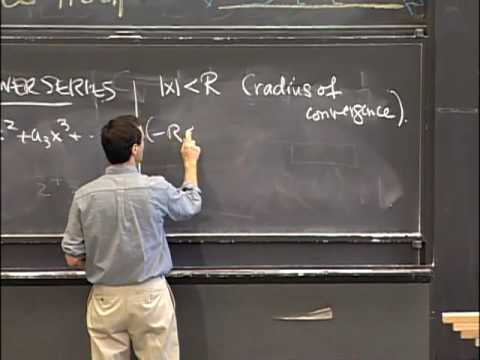
Opening Pointwise and Uniform Convergence of Sequences of Functions
Pointwise and Uniform Convergence of Sequences of Functions
- Length
- 1 h 9 min
- Level
- Undergraduate
- Recorded
- MIT2022
Opening Pointwise and Uniform Convergence of Sequences of Functions
Chapter 1 of 9: Integration by parts and Fourier series
Rodriguez proves the Riemann-Lebesgue lemma, then exhibits continuous functions whose pointwise limit is discontinuous.
Real analysis examines sequences of functions and their convergence properties, moving beyond sequences of real numbers. The discussion applies integration by parts to prove the Riemann-Lebesgue lemma for Fourier series coefficients. It uses power series to motivate how limits of functions behave. The text defines pointwise convergence and shows with examples that continuous functions can have discontinuous pointwise limits. It introduces uniform convergence as a global property on an interval and demonstrates that uniform convergence implies pointwise convergence, but not vice versa.
Real analysis examines sequences of functions and their convergence properties, moving beyond sequences of real numbers. The discussion applies integration by parts to prove the Riemann-Lebesgue lemma for Fourier series coefficients. It uses power series to motivate how limits of functions behave. The text defines pointwise convergence and shows with examples that continuous functions can have discontinuous pointwise limits. It introduces uniform convergence as a global property on an interval and demonstrates that uniform convergence implies pointwise convergence, but not vice versa.

This lecture
Lecture 23 of 25 of Real Analysis.
Choose a node to see how it connects to this lecture. What comes before is on the leftat the top. What comes after is on the rightat the bottom. The ring is what it teaches. People and places are above.
Press a chosen node again to open it.
Your comment is kept while you sign up.Sign in