Opening Preferences and Utility Function
Preferences and Utility Function
- Length
- 41 min
- Level
- Introductory
- Recorded
- MIT2025
Opening Preferences and Utility Function
Chapter 1 of 7: Before the lecture
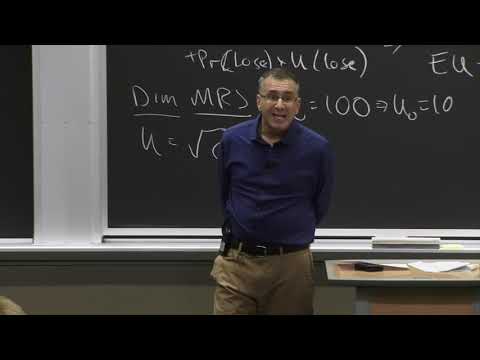
Consumer preferences and choice derive from three foundational axioms: completeness, transitivity, and non-satiation. Gruber maps these choices into indifference curves and introduces the utility function as a mathematical representation of consumer preferences. The lecture establishes four properties of indifference curves, notably their downward slope and convexity to the origin. Diminishing marginal utility and the marginal rate of substitution explain how consumers trade off goods like pizza and cookies.

Your comment is kept while you sign up.Sign in
Derives the utility function and indifference curves from consumer preference axioms.
Consumer preferences and choice derive from three foundational axioms: completeness, transitivity, and non-satiation. Gruber maps these choices into indifference curves and introduces the utility function as a mathematical representation of consumer preferences. The lecture establishes four properties of indifference curves, notably their downward slope and convexity to the origin. Diminishing marginal utility and the marginal rate of substitution explain how consumers trade off goods like pizza and cookies.
This lecture
Lecture 2 of 26 of Principles of Microeconomics.
Choose a node to see how it connects to this lecture. What comes before is on the leftat the top. What comes after is on the rightat the bottom. The ring is what it teaches. People and places are above. Other lectures and books are below.
Press a chosen node again to open it.