Opening Transition Metals: Crystal Field Theory Part II
Transition Metals: Crystal Field Theory Part II
- Length
- 35 min
- Level
- Undergraduate
- Recorded
- MIT2017
Opening Transition Metals: Crystal Field Theory Part II
Chapter 1 of 6: Before the lecture
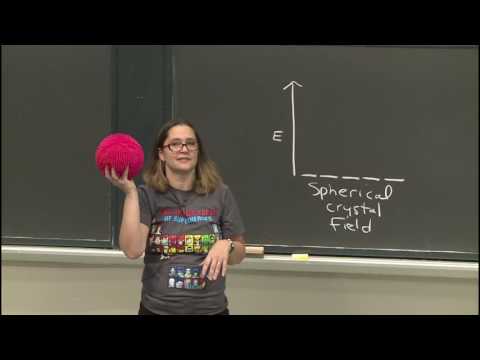
Crystal field theory for tetrahedral and square planar complexes extends the octahedral splitting model to explain the color and magnetism of transition metal compounds. Drennan opens with nickel chloride solutions that change color as weak, intermediate and strong field ligands displace each other, shifting the splitting energy and absorbed wavelength. In the tetrahedral diagram, off-axis ligands invert the octahedral pattern and keep the splitting small, so these complexes are always high spin. Square planar geometry puts ligands on the axes, pushing highest and producing a large splitting. Nickel enzymes that help stomach bacteria survive acid or remove carbon dioxide lead into the final problem. Diamagnetism versus paramagnetism then fixes the geometry of an unknown nickel site, building on octahedral theory and d-electron counting.
Your comment is kept while you sign up.Sign in
Drennan uses magnetic data to decide whether a nickel enzyme's active site is tetrahedral or square planar.
Crystal field theory for tetrahedral and square planar complexes extends the octahedral splitting model to explain the color and magnetism of transition metal compounds. Drennan opens with nickel chloride solutions that change color as weak, intermediate and strong field ligands displace each other, shifting the splitting energy and absorbed wavelength. In the tetrahedral diagram, off-axis ligands invert the octahedral pattern and keep the splitting small, so these complexes are always high spin. Square planar geometry puts ligands on the axes, pushing highest and producing a large splitting. Nickel enzymes that help stomach bacteria survive acid or remove carbon dioxide lead into the final problem. Diamagnetism versus paramagnetism then fixes the geometry of an unknown nickel site, building on octahedral theory and d-electron counting.
Chemical Principles: The Quest for Insight
This lecture
Lecture 28 of 34 of Principles of Chemical Science.
Choose a node to see how it connects to this lecture. What comes before is on the leftat the top. What comes after is on the rightat the bottom. The ring is what it teaches. People and places are above. Other lectures and books are below.
Press a chosen node again to open it.