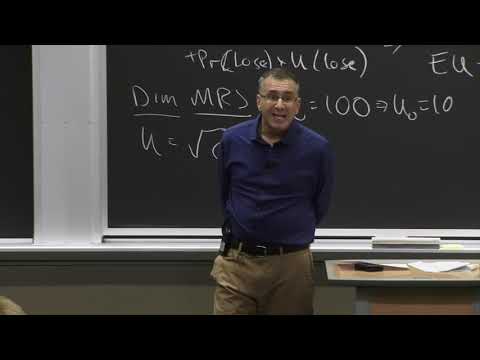
Gruber derives expected utility theory to model risk aversion and insurance markets under uncertainty.
Decisions under uncertainty start from expected utility theory, which replaces dollar values with concave utility functions to model risk aversion. Diminishing marginal utility of consumption makes individuals value potential losses more than equivalent gains, explaining why people reject fair bets and purchase insurance. Information asymmetry introduces market failures like the lemons problem and adverse selection, where hidden knowledge prevents mutually beneficial transactions. These mechanisms establish the rationale for public intervention and government-provided insurance. Applications range from evaluating state lotteries to calculating individual risk premiums.
Is it for you
Summary written with AI from the lecture and its descriptionWhat you will take away
- 1Expected utility theory weights utility outcomes by probabilities rather than relying solely on expected dollar values.
- 2Concave utility functions represent risk aversion because individuals experience diminishing marginal utility of consumption.
- 3Insurance transactions feature risk premiums where risk-averse individuals pay extra to avoid potential losses.
- 4Information asymmetry generates market failures such as the lemons problem and adverse selection in insurance.
Before you start
- Good fit if
- Students taking an introductory microeconomics course who know basic probability and utility maximization. Explains the material in order, conversational in tone. Takes questions along the way.
- Start at
- Clarity
- Density
- Stands alone