
Death
Shelly KaganRigorous analytic metaphysics and moral philosophy examining personal identity, mind-body dualism vs. physicalism, Plato's Phaedo, immortality, and whether being dead can harm a person.
Syllabus
22Metaphysics vs. Value Theory of Death
Seated cross-legged on his desk at Yale, Shelly Kagan maps out the analytic philosophical questions surrounding personhood, survival, and rationality in the face of mortality.
The Nature of Persons — Mind-Body Dualism vs. Physicalism
Precise conceptual dissection of Cartesian substance dualism vs. functionalist physicalism—separating what a person is made of from whether consciousness reduces to brain states.
Inference to the Best Explanation & Arguments for Immaterial Mind
Uses abductive reasoning (inference to the best explanation) to test whether creativity, intentionality, or qualia outrun physical mechanisms.
Plato's Phaedo, Theory of Forms & Epistemic Arguments
Reconstructs Plato's Phaedo premise-by-premise like a modern logic paper—testing Plato's argument from eternal Forms and recollection.
Arguments for the existence of the soul, Part III: Free will and near-death experiences
Professor Kagan critically examines arguments for an immaterial soul, focusing on the incompatibility of free will with determinism and the explanatory challenges posed by near-death experiences. The lecture introduces Descartes's dualist argument for the distinction between mind and body.
Arguments for the existence of the soul, Part IV; Plato, Part I
This lecture critically examines the Cartesian argument for the soul's existence before transitioning to Plato's metaphysical framework in the Phaedo. It elaborates on the theory of Platonic Forms and their role in Plato's argument for the soul's immortality.
Plato, Part II: Arguments for the immortality of the soul
This lecture analyzes Plato's arguments for the soul's immortality as presented in the Phaedo, including the argument from the nature of the Forms, the argument from recycling, and the argument from recollection.
Plato, Part III: Arguments for the immortality of the soul (cont.)
This lecture analyzes Plato's argument from simplicity for the immortality of the soul as presented in the Phaedo. It examines the proposition that the soul, being without parts, is thus indestructible and considers objections raised by Cebes and Simmias regarding this premise.
Plato, Part IV: Arguments for the Immortality of the Soul
This lecture dissects Plato's "argument from simplicity," asserting the soul's changeless and indestructible nature, and the "argument from essential properties" regarding the soul's inherent characteristics.
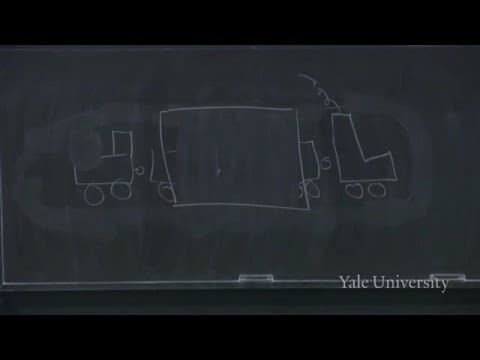
Personal Identity, Part I: Identity Across Space and Time and the Soul Theory
The lecture introduces the metaphysical question of personal identity, analyzing the "soul theory" as a key to identity across time and space, while examining its inherent difficulties.
Personal Identity, Part II: The Body Theory and the Personality Theory
This session explores the body theory, identifying an individual by their physical form, and the personality theory, linking identity to an individual's unique beliefs and memories.
Personal Identity, Part III: Objections to the Personality Theory
This lecture scrutinizes the personality theory of identity, focusing on the "problem of duplication" and exploring scenarios where a personality is transferred or exported to multiple bodies.
Personal Identity, Part IV: What Matters?
The lecture refines the personality theory by introducing a "no branching" clause, extending this requirement to other identity theories, and shifting the focus from "what it takes to survive" to "what matters in survival."
What Matters (cont.); The Nature of Death, Part I
This session proposes that what matters in survival is the future existence of a similar personality. It then commences an inquiry into the nature of death, focusing on critical bodily and mental functions.
The Nature of Death (cont.); Believing You Will Die
This lecture examines the state of being dead, specifying the capacity for "P-functioning" while accommodating exceptions like sleep and coma. It then explores the psychological phenomenon of denying one's own mortality, referencing Tolstoy's Ivan Ilych.
Dying Alone; The Badness of Death, Part I
Kagan analyzes Tolstoy's Ivan Ilych as a typical portrayal of mortality denial. The lecture then debates the claim "we all die alone" and considers if the primary badness of death lies in its effects on survivors.
The Badness of Death, Part II: The Deprivation Account
This lecture details the "deprivation account" of death's badness, asserting that ceasing to exist deprives one of life's good things. It distinguishes intrinsic badness from comparative badness, engaging with Epicurus's views.
The Badness of Death, Part III; Immortality, Part I
The session examines if pre-birth non-existence is bad, referencing Nagle, Feldman, and Parfit. It then initiates an exploration of immortality, considering its desirability under various conditions and Bernard Williams's critique of eternal life.
Immortality Part II; The Value of Life, Part I
This lecture continues to assess the desirability of immortality and transitions to theories of well-being. It introduces hedonism and critiques it using Nozick's "experience machine" thought experiment.
The Value of Life, Part II; Other Bad Aspects of Death, Part I
This lecture compares the neutral and valuable container theories of life's worth. It then pivots to additional negative aspects of death, including its inevitability, variability, and unpredictability.
Other Bad Aspects of Death, Part II
This lecture explores further negative aspects of death, such as its ubiquity, and contemplates the value of the human condition. It also distinguishes between changes in behavior caused by reflecting on mortality and reasons to change behavior.
Fear of Death
The lecture examines how thoughts of death influence living and evaluates the appropriateness of fear as an emotional response. It differentiates between fearing the process of dying and fearing death itself, considering other negative emotions like anger and sadness.