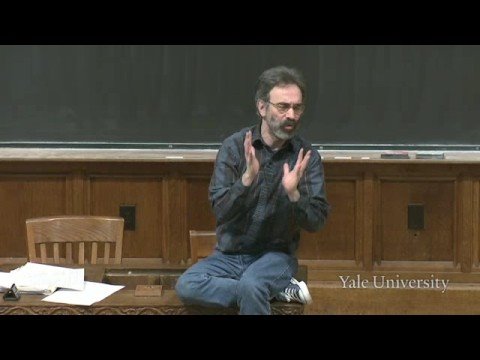
Opening A History of Philosophy: Berkeley's Replies to Objections
A History of Philosophy: Berkeley's Replies to Objections
- Length
- 1 h 4 min
- Level
- Undergraduate
- Recorded
- Wheaton College2015
Opening A History of Philosophy: Berkeley's Replies to Objections
Chapter 1 of 8: Review of Berkeley's mentalism
Examines George Berkeley's philosophical responses to common objections against his immaterialist theory of idealism.
George Berkeley defends his immaterialist theory of idealism by responding to common objections concerning the ordered uniformity of nature, the problem of evil, and the doctrine of the incarnation. The lecture starts from the distinction between active and passive ideas, arguing that involuntary sense perceptions require a supreme divine mind as their cause. It proceeds through student questions to examine how Berkeley accounts for physical suffering through the greater good argument and how other minds are recognized through analogical experience. The discussion concludes by contrasting Berkeley's mentalism with John Locke's dualism and introducing David Hume's subsequent skepticism.
George Berkeley defends his immaterialist theory of idealism by responding to common objections concerning the ordered uniformity of nature, the problem of evil, and the doctrine of the incarnation. The lecture starts from the distinction between active and passive ideas, arguing that involuntary sense perceptions require a supreme divine mind as their cause. It proceeds through student questions to examine how Berkeley accounts for physical suffering through the greater good argument and how other minds are recognized through analogical experience. The discussion concludes by contrasting Berkeley's mentalism with John Locke's dualism and introducing David Hume's subsequent skepticism.
Kaufman's selection
Principles of Natural Knowledge

This lecture
Lecture 45 of 81 of A History of Western Philosophy.
Choose a node to see how it connects to this lecture. What comes before is on the leftat the top. What comes after is on the rightat the bottom. The ring is what it teaches. People and places are above. Other lectures and books are below.
Press a chosen node again to open it.
Your comment is kept while you sign up.Sign in