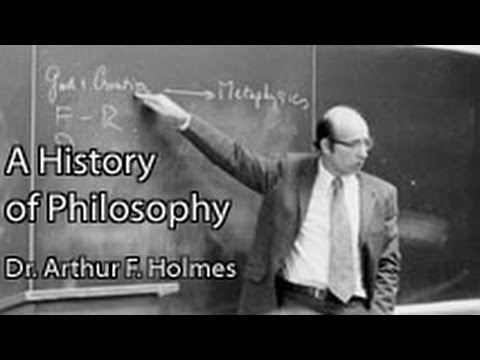
Opening American Pragmatism (A History of Philosophy, Lecture 64)
American Pragmatism (A History of Philosophy, Lecture 64)
- Length
- 1 h 6 min
- Level
- Undergraduate
- Recorded
- Wheaton College2015
Opening American Pragmatism (A History of Philosophy, Lecture 64)
Chapter 1 of 6: Before the lecture
Traces the origins of American Pragmatism through Peirce's belief fixation and James's psychological view of truth.
American Pragmatism traces the shift from classical metaphysics and mechanistic models to process philosophy and organic worldviews, examining the foundational contributions of Charles Sanders Peirce and William James. It establishes the core characteristics of pragmatism, including the primacy of practical experience over theoretical abstraction, organic interrelatedness, and methodological naturalism. Holmes details Peirce's rejection of Cartesian doubt in favor of scientific belief fixation. He contrasts Peirce's realist approach with James's psychological empiricism. Through these thinkers, pragmatism redefines truth as practical workability and cash value within human experience.
American Pragmatism traces the shift from classical metaphysics and mechanistic models to process philosophy and organic worldviews, examining the foundational contributions of Charles Sanders Peirce and William James. It establishes the core characteristics of pragmatism, including the primacy of practical experience over theoretical abstraction, organic interrelatedness, and methodological naturalism. Holmes details Peirce's rejection of Cartesian doubt in favor of scientific belief fixation. He contrasts Peirce's realist approach with James's psychological empiricism. Through these thinkers, pragmatism redefines truth as practical workability and cash value within human experience.
Science and the Modern World
Essay on Man
The Quest for Certainty
The Monist
The Reconstruction of Philosophy
Essays in Experimental Logic
Popular Science Monthly articles

This lecture
Lecture 64 of 81 of A History of Western Philosophy.
Choose a node to see how it connects to this lecture. What comes before is on the leftat the top. What comes after is on the rightat the bottom. The ring is what it teaches. People and places are above. Other lectures and books are below.
Press a chosen node again to open it.
Your comment is kept while you sign up.Sign in
Collected Papers
The Fixation of Belief
How to Make Our Ideas Clear
Stumph
Popular Science Monthly
Varieties of Religious Experience


