Opening Interactions with the Physical Environment
Interactions with the Physical Environment
- Length
- 49 min
- Level
- Undergraduate
- Recorded
- Yale University2009
Opening Interactions with the Physical Environment
Chapter 1 of 2: Hibernation physiology in small mammals
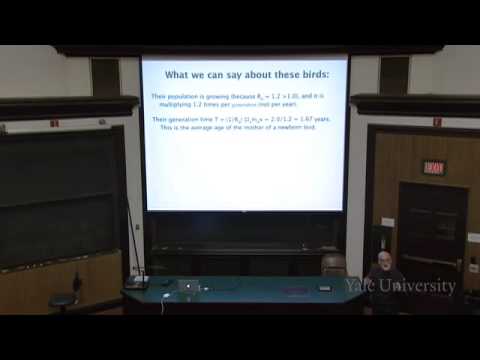
Physiological ecology examines how organisms regulate internal states within preferred environmental ranges through specific adaptations. The lecture investigates the physical constraints of hibernation in mammals, contrasting the deep torpor of chipmunks with the winter sleep of brown bears. It applies surface area to volume scaling laws to explain why neither extremely small animals nor massive ones can achieve true hibernation. The discussion then traces the evaporative water loss tradeoff in birds and concludes by analyzing soil water availability for plant roots.
Your comment is kept while you sign up.Sign in
Applies surface area to volume scaling laws to explain why mammals like chipmunks hibernate while bears only sleep.
Physiological ecology examines how organisms regulate internal states within preferred environmental ranges through specific adaptations. The lecture investigates the physical constraints of hibernation in mammals, contrasting the deep torpor of chipmunks with the winter sleep of brown bears. It applies surface area to volume scaling laws to explain why neither extremely small animals nor massive ones can achieve true hibernation. The discussion then traces the evaporative water loss tradeoff in birds and concludes by analyzing soil water availability for plant roots.
This lecture
Lecture 25 of 36 of Principles of Evolution, Ecology, and Behavior.
Choose a node to see how it connects to this lecture. What comes before is on the leftat the top. What comes after is on the rightat the bottom. The ring is what it teaches. People and places are above. Other lectures and books are below.
Press a chosen node again to open it.