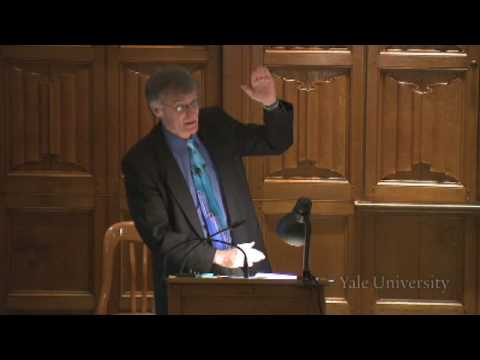
Opening To Appomattox and Beyond: The End of the War and a Search for Meanings
To Appomattox and Beyond: The End of the War and a Search for Meanings
- Length
- 51 min
- Level
- Undergraduate
- Recorded
- Yale University2008
Opening To Appomattox and Beyond: The End of the War and a Search for Meanings
Chapter 1 of 6: Melville and Civil War Poetry
The 1864 campaigns of the American Civil War, from Grant's attrition in Virginia to Sherman's March to the Sea, form the core of session 19 of Yale's HIST 119. Blight opens with a reading of Herman Melville's "On the Slain Collegians" and notes how much of Melville's and Emily Dickinson's poetry came out of the war's dead. He follows Grant's shift from capturing Richmond to destroying Lee's army, and sketches Lee's engineering background and aggressive temperament. The Wilderness, Spotsylvania, Cold Harbor and the Crater show the casualties and the strain on Northern morale. Sherman's Georgia campaign and Sheridan's Shenandoah Valley raids illustrate war on civilian resources. Blight closes with the Memorial Day held by freed African Americans in Charleston on May 1, 1865.
Your comment is kept while you sign up.Sign in
Blight sets Melville's "On the Slain Collegians" beside Grant's attrition and Charleston's first Memorial Day.
The 1864 campaigns of the American Civil War, from Grant's attrition in Virginia to Sherman's March to the Sea, form the core of session 19 of Yale's HIST 119. Blight opens with a reading of Herman Melville's "On the Slain Collegians" and notes how much of Melville's and Emily Dickinson's poetry came out of the war's dead. He follows Grant's shift from capturing Richmond to destroying Lee's army, and sketches Lee's engineering background and aggressive temperament. The Wilderness, Spotsylvania, Cold Harbor and the Crater show the casualties and the strain on Northern morale. Sherman's Georgia campaign and Sheridan's Shenandoah Valley raids illustrate war on civilian resources. Blight closes with the Memorial Day held by freed African Americans in Charleston on May 1, 1865.
Memoirs of General William T. Sherman
Reading the Man
Harper's Weekly
This lecture
Lecture 5 of 6 of The Civil War and Reconstruction Era, 1845–1877.
Choose a node to see how it connects to this lecture. What comes before is on the leftat the top. What comes after is on the rightat the bottom. The ring is what it teaches. People and places are above. Other lectures and books are below.
Press a chosen node again to open it.