Martin Kleppmann
Professor · University of Cambridge · Distinguished · author of Designing Data-Intensive Applications
Associate Professor at the University of Cambridge, researcher in local-first software and CRDTs, and author of Designing Data-Intensive Applications.
- lectures
- 30
- series
- 1
- hours
- 14
Start here
- Case Study: Google Spanner, TrueTime & Global Transactionsfrom Kleppmann, Designing Data-Intensive Applications

- The Raft Consensus Algorithm: Leader Election & Log Replicationfrom Kleppmann, Designing Data-Intensive Applications

- Logical Time: Lamport Timestamps & Vector Clocksfrom Kleppmann, Designing Data-Intensive Applications
Series and courses
Cambridge CST: Distributed Systems
Open the course
- 1Introduction to Distributed Systems
- 2Remote Procedure Calls (RPC), Idempotence & Marshalling
- 3System Models: Network Faults, Node Crashes & Synchrony
- 4Physical Time, Clock Skew, NTP & Monotonic Clocks
Show 17 moreShow fewer
- 5Clock Synchronization, Cristian's Algorithm & NTP
- 6Causality & Lamport's Happens-Before Relation
- 7Logical Time: Lamport Timestamps & Vector Clocks
- 8Broadcast Ordering
- 9Replication: Leader-Based, Multi-Leader & Quorum Protocols
- 10Consensus: Total Order Broadcast & Fault-Tolerant Agreement
- 11The Raft Consensus Algorithm: Leader Election & Log Replication
- 12Two-Phase Commit
- 13Linearizability
- 14Eventual Consistency
- 15Collaboration Software
- 16Case Study: Google Spanner, TrueTime & Global Transactions
- 17The Two Generals' Problem
- 18The Byzantine Generals Problem
- 19Broadcast Algorithms
- 20Distributed Systems: Quorums
- 21Distributed Systems: State Machine Replication
Talks
In these lectures
- Google Spanner uses Paxos for shard replication, two-phase locking for serializable isolation, and two-phase commit for atomicity across multiple shards.Case Study: Google Spanner, TrueTime & Global Transactions
- Nodes in Raft operate in one of three states: follower, candidate, or leader, always within a specific monotonic term number.The Raft Consensus Algorithm: Leader Election & Log Replication
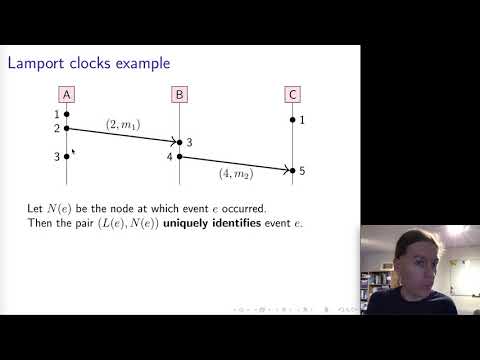
- Physical clocks can produce timestamps that are inconsistent with causality due to clock drift.Logical Time: Lamport Timestamps & Vector Clocks
Draws on
People cited in the lectures, at the moment of the citation.
- Leslie LamportPublished the Lamport clocks algorithm in 1978
- Alex GoodCollaborator and Automerge community member
- Sun et al.1998 paper presenting the GOTO control algorithm
- Nichols et al.1995 paper presenting the Jupiter central server algorithm
- Ressel et al.1996 paper presenting the adOPTed algorithm with n-dimensional history
- Shapiro et al.2011 paper defining CRDTs
Same subject, Computer Systems & Software
Connections
41Their places, courses, books and lectures.
Institutions7
Show 1 moreShow fewer
Lectures30
- Case Study: Google Spanner, TrueTime & Global Transactions
- The Raft Consensus Algorithm: Leader Election & Log Replication
- Logical Time: Lamport Timestamps & Vector Clocks
- Causality & Lamport's Happens-Before Relation
- Thinking in Events: From Databases to Distributed Collaboration Software
- Broadcast Ordering
Show 24 moreShow fewer
- Linearizability
- Two-Phase Commit
- Physical Time, Clock Skew, NTP & Monotonic Clocks
- Clock Synchronization, Cristian's Algorithm & NTP
- Consensus: Total Order Broadcast & Fault-Tolerant Agreement
- Remote Procedure Calls (RPC), Idempotence & Marshalling
- Replication: Leader-Based, Multi-Leader & Quorum Protocols
- Collaboration Software
- Eventual Consistency
- Introduction to Distributed Systems
- System Models: Network Faults, Node Crashes & Synchrony
- Distributed Systems: Quorums
- The Byzantine Generals Problem
- The Two Generals' Problem
- Conflict Resolution for Eventual Consistency
- Automerge: A Foundation for Local-First Collaboration Software
- Broadcast Algorithms
- The Past, Present, and Future of Local-First Software
- CRDTs and the Quest for Distributed Consistency
- CRDTs: The Hard Parts
- Transactions: Myths, Surprises, and Opportunities
- Distributed Systems: State Machine Replication
- Local-First in an Unstable World
- Correctness Proofs of Distributed Systems with Isabelle