
Economic Applications of Game Theory
Formal analysis of strategic interaction in economic environments, developing static and dynamic games of complete and incomplete information, signaling, bargaining, and auction theory.
Syllabus
20Introduction to Individual Decision-Making
This introductory lecture establishes the foundational principles of game theory, a mathematical framework for analyzing strategic decision-making in interactive contexts. It defines the core concepts and scope of the course.
Representation of Games
This session delves into formal methods for representing games, including extensive-form games to depict sequences of moves and strategic-form games for simultaneous decisions. Key concepts of strategy and interactive decision-making are discussed.
Dominance
Examining the Prisoner's Dilemma, this lecture introduces the fundamental concept of dominant strategies and best responses. It elucidates how to systematically identify and eliminate suboptimal strategies in competitive scenarios.
Rationalizability
This lecture introduces rationalizability, a concept defining the set of strategies that rational players might choose given common knowledge of rationality. It explores how iterative elimination of strictly dominated strategies identifies rationalizable actions.
Nash Equilibrium
This session rigorously defines the Nash equilibrium, a central concept where no player can unilaterally improve their outcome by changing strategy. It explores applications, including mixed strategies in games like hide-and-seek.
Imperfect Competition
Focusing on market structures, this lecture analyzes imperfect competition, exploring how firms make pricing and output decisions in oligopolies and monopolies. Real-world examples illustrate competitive dynamics.
Zero-Sum Games
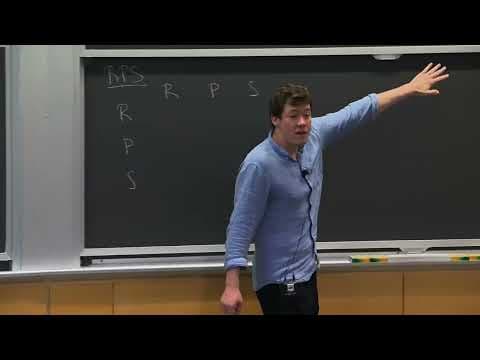
This lecture introduces the formal definition and properties of zero-sum games, where players' interests are in direct opposition. It analyzes strategic decision-making in contexts such as classic board games, laying groundwork for minimax strategies and their relationship to Nash equilibrium.
Backward Induction
Introducing backward induction, this lecture explains the process of solving sequential games by reasoning from the end of the game tree. It identifies optimal choices by considering all possible future actions.
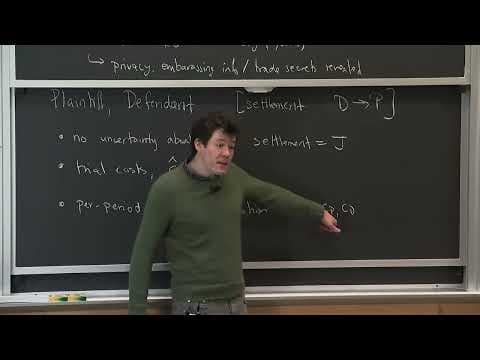
Negotiation
This lecture explores negotiation as a direct application of backward induction, demonstrating its utility through two concrete economic scenarios: pre-trial hearing settlements and price haggling. The session formally analyzes strategic decision-making in sequential games.
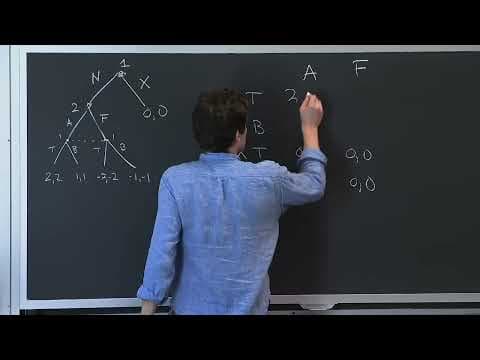
Subgame-Perfect Nash Equilibrium
This session defines the subgame-perfect Nash equilibrium, a refinement of the Nash equilibrium applicable to extensive-form games. It ensures that strategies are optimal not just globally, but within every subgame.
One-Shot Deviation Principle and Bargaining
Exploring multi-stage games, this lecture introduces the one-shot deviation principle, a powerful tool for verifying subgame perfect equilibria. It also applies these concepts to advanced bargaining models.
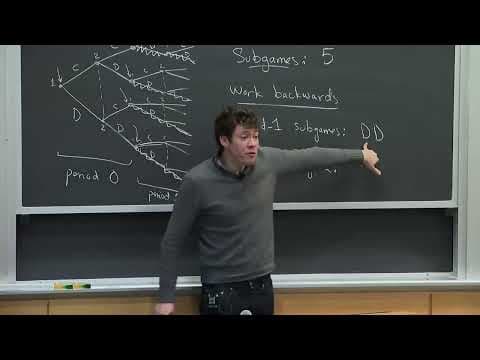
Finitely Repeated Games
This lecture analyzes finitely repeated games, exploring how the repetition of a stage game influences strategic choices and potential for cooperation. The Prisoner's Dilemma serves as a central example for demonstration.
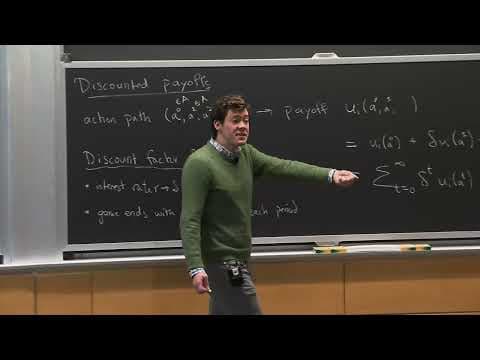
Infinitely Repeated Games
Delving into infinitely repeated games, this session demonstrates how indefinite play can sustain cooperative outcomes not possible in one-shot games. It discusses the role of discount factors and future incentives.
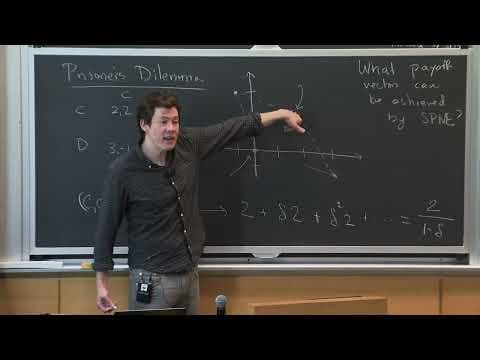
Folk Theorem
This lecture formalizes the Folk Theorem, which posits that in infinitely repeated games, any individually rational and feasible payoff can be sustained as a Nash equilibrium. It highlights the vast range of possible cooperative and punitive strategies.
Implicit Cartels
Examining implicit cartels, this lecture explores how independent market participants can collaborate to dominate markets and improve profits without explicit agreements. OPEC serves as a classic economic illustration.
Bayesian Games
This lecture introduces Bayesian games, a framework for analyzing strategic interactions under incomplete information. Players' types, preferences, and beliefs about other players' information are modeled probabilistically.
Bayesian Nash Equilibrium: Applications
This session extends the discussion of Bayesian Nash Equilibrium, applying it to practical economic scenarios. Specific applications include Cournot competition under asymmetric information and the strategic design of auctions.
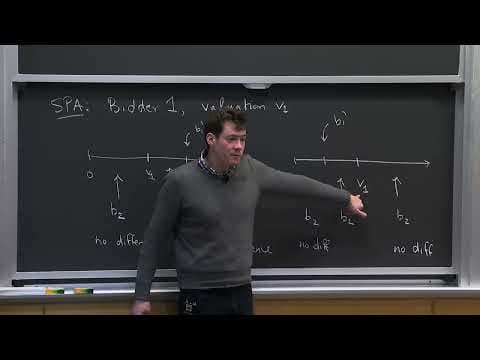
Auctions
Continuing the analysis of auctions, this lecture delves into strategic bidding behavior, introducing key formats such as first-price and second-price auctions. Participants maximize payoffs based on valuations and anticipated competitor actions.
Revenue Equivalence
This lecture presents the concept of revenue equivalence in auction theory, demonstrating that under specific conditions, various auction mechanisms yield the same expected revenue for the seller. It outlines the underlying assumptions and implications.
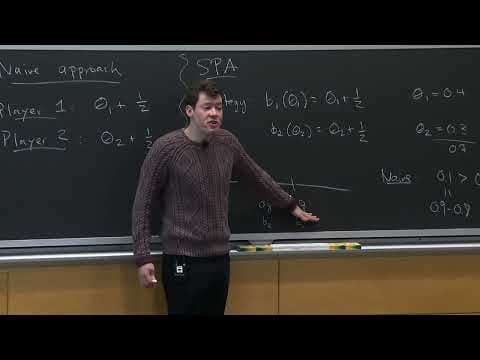
Ad Auctions
Reviewing revenue equivalence, this lecture transitions to practical applications in ad auctions, particularly keyword search auctions like those used by Google. It explores strategic bidding in digital advertising markets.