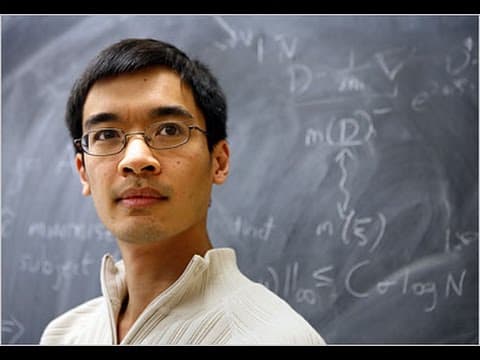
Structure and Randomness in the Prime Numbers
Shows how analytic number theory decomposes arithmetic sequences into structured periodic components and pseudorandom noise—unlocking arbitrary-length arithmetic progressions in the primes.
A globally acclaimed public research university, renowned for its comprehensive excellence across arts, sciences, medicine, and engineering, with significant societal impact.
Self-contained research seminars, public lectures, and invited colloquia.
Shows how analytic number theory decomposes arithmetic sequences into structured periodic components and pseudorandom noise—unlocking arbitrary-length arithmetic progressions in the primes.
A seminal talk by Alan Kay, a pioneer in computer science, reflecting on the profound impact of simplicity in the design of complex systems and programming languages.
Terence Tao presents an overview of Yves Meyer's groundbreaking work on wavelets, celebrating the Abel Prize laureate and exploring the evolution of mathematics and research motivation.
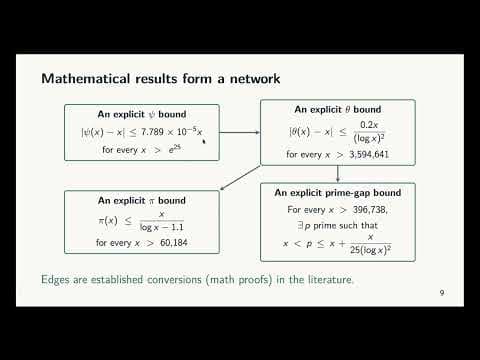
Exploring the Integrated Explicit Analytic Number Theory Network (IEANTN), a system designed to formalize and organize complex results in analytic number theory using Lean.
Explore the sophisticated mathematical models applied to crime prediction, focusing on real-world applications in law enforcement and the analysis of gang dynamics.
From a Bell Labs pioneer, a detailed account of the invention and evolution of quantum cascade lasers, tracing their path from laboratory curiosity to indispensable tools in various fields.
Professors, researchers, and invited lecturers recorded at UCLA.
Discrete proof invariants, stochastic conditioning, pseudorandomness, and P vs. NP
MIT · Harvard University · UCLA +2
Browse, filter, and sort every lecture from UCLA.