Courses
105 multi-lecture university courses with ordered session lists.

Nonlinear Dynamics and Chaos
Flows on the line and circle, saddle-node and pitchfork bifurcations, two-dimensional phase planes, limit cycles, Hopf bifurcations, Lorenz equations, strange attractors, and fractals.

Probability
Harvard's celebrated probability sequence building story proofs, conditioning, Bayes' theorem, indicator random variables, continuous distributions, moment generating functions, and Markov chains.

Real Analysis
Dedekind cuts construction of the reals, metric space topology, compactness, Heine-Borel theorem, connected sets, Cauchy sequences, uniform continuity, and function spaces.

IAS Mathematics: Hodge Theory and O-Minimality in Algebraic Geometry
School of Mathematics seminar series on period mappings, variations of Hodge structure, tame geometry via o-minimal structures, and applications to the Zilber-Pink conjectures.
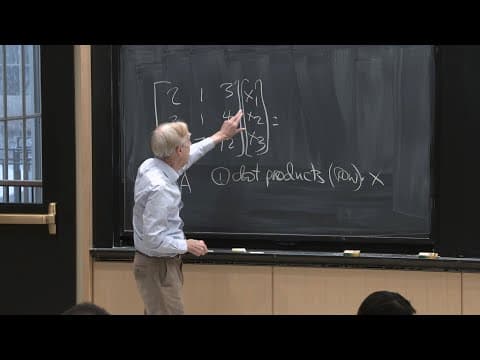

Matrix Methods in Data Analysis, Signal Processing, and Machine Learning
Gilbert Strang bridges numerical linear algebra and modern machine learning: singular value decomposition, low-rank approximations, Eckart-Young theorem, randomized linear algebra, and stochastic gradient descent.
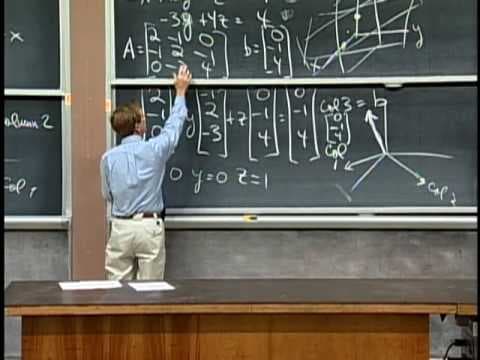
Linear Algebra
Gilbert Strang's gold-standard MIT undergraduate course building geometric and algebraic intuition for systems of equations, vector spaces, orthogonality, determinants, and eigenvalues.
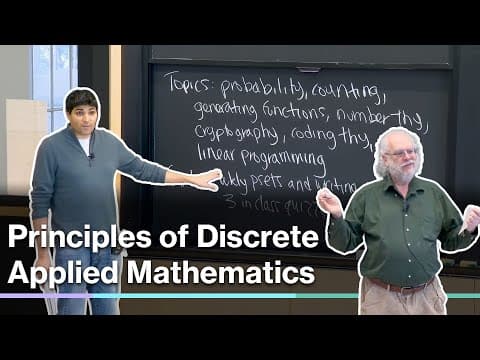
Principles of Discrete Applied Mathematics
Combinatorial and algebraic methods in applied mathematics, covering generating functions, probabilistic method, extremal graph theory, linear programming duality, and error-correcting codes.

Undergraduate Student Lectures
Authentic Mathematical Institute lectures at the University of Oxford introducing rigorous proof construction, real analysis, linear algebra, groups, and applied differential equations.
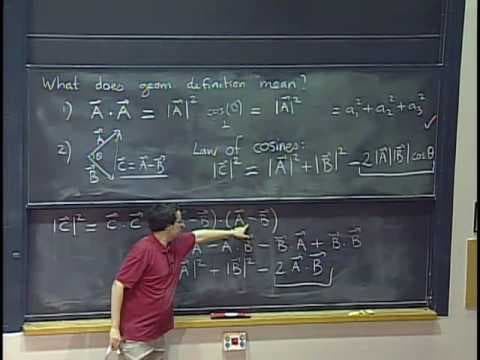
Multivariable Calculus
Vector geometry, matrices, partial derivatives, Lagrange multipliers, multiple integrals, line and surface integrals, Green's theorem, Stokes' theorem, and the divergence theorem.
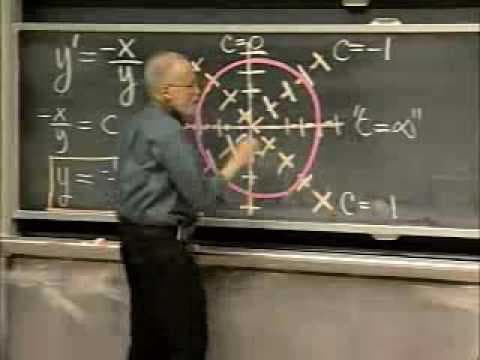
Differential Equations
Direction fields, first-order and second-order linear ODEs, complex exponentials, resonance, Fourier series, Laplace transforms, Dirac delta impulses, and linear systems.
Real Analysis
Rigorous proof-based analysis of the real numbers, completeness, metric compactness, continuity, uniform convergence, differentiation, and the Riemann integral.