
Introduction to Robotics
Prof. Oussama KhatibSpatial descriptions, Denavit-Hartenberg forward and inverse kinematics, manipulator Jacobians, Lagrangian dynamics, trajectory generation, and operational-space force control.
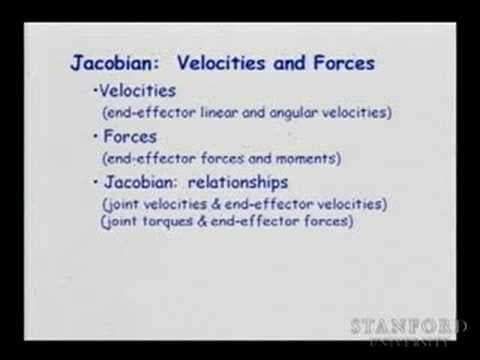
Syllabus
16Lecture 1 | Introduction to Robotics
This inaugural lecture for Stanford's CS223A provides an overview of core robotics topics, including spatial descriptions, kinematics, dynamics, motion planning, and control theory. It establishes the course's foundational scope.
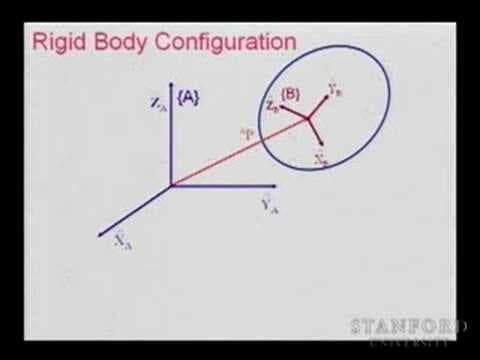
Lecture 2 | Introduction to Robotics
Lecture by Professor Oussama Khatib for Introduction to Robotics (CS223A) in the Stanford Computer Science Department. Professor Khatib shows a video on Walking Machines then goes into his first topic -- Kinematics.
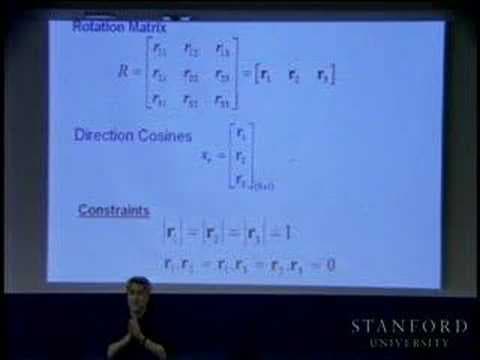
Lecture 3 | Introduction to Robotics
This lecture, part of Stanford's CS223A, introduces fundamental concepts in robotics, focusing on kinematics and the rigorous spatial descriptions required for manipulator analysis. It lays the groundwork for understanding robot arm configuration and movement.
Lecture 4 | Introduction to Robotics
This lecture, part of Stanford's CS223A, introduces the fundamental concepts of manipulator kinematics, focusing on spatial descriptions and the formulation of forward kinematics for robotic systems. Professor Khatib begins with an overview before delving into the mathematical representations.
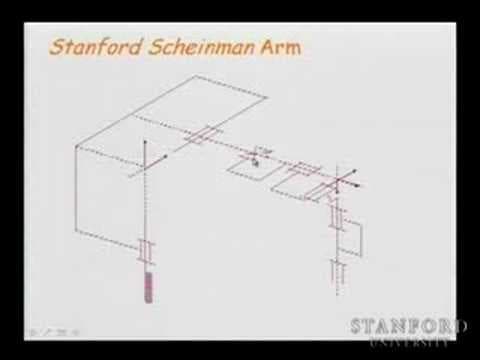
Lecture 5 | Introduction to Robotics
Lecture by Professor Oussama Khatib for Introduction to Robotics (CS223A) in the Stanford Computer Science Department. Professor Khatib shows a short video on the Brachiation Robot, then goes into a lecture on Frame Attachment.
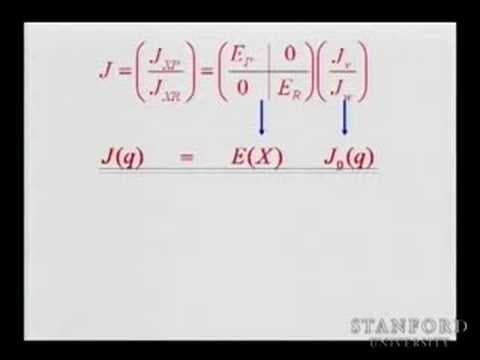
Lecture 6 | Introduction to Robotics
This lecture, part of Stanford's CS223A, delves into instantaneous kinematics and the Jacobian matrix, foundational concepts for analyzing robot motion and control. Professor Khatib details their application in understanding manipulator velocity and force relationships.
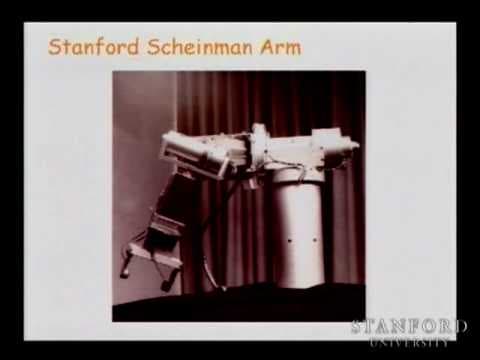
Lecture 7 | Introduction to Robotics
Lecture by Professor Oussama Khatib for Introduction to Robotics (CS223A) in the Stanford Computer Science Department. Professor Khatib shows a short video on a robot playing beach volleyball, then continues The Jacobian.
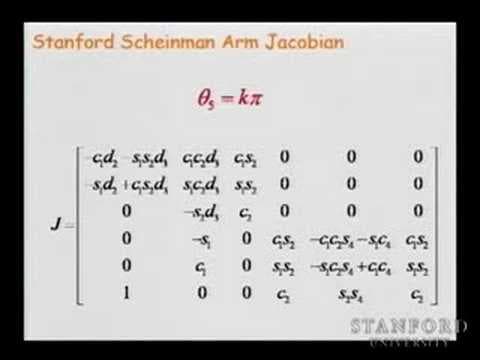
Lecture 8: Kinematic Singularity and the Jacobian (CS223A)
This lecture delves into the concepts of kinematic singularity and the Jacobian matrix, crucial for understanding robot manipulator control and motion analysis. It concludes the discussion on these fundamental topics within robotics.
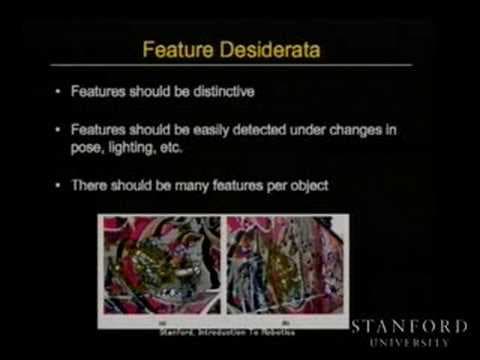
Lecture 9: Perception and Sensing in Robotic Mobility and Manipulation (CS223A)
Guest lecturer Gregory Hager explores the essential role of perception and sensing systems in both mobile robots and robotic manipulators. The session examines how robots acquire and interpret environmental data for navigation and interaction.
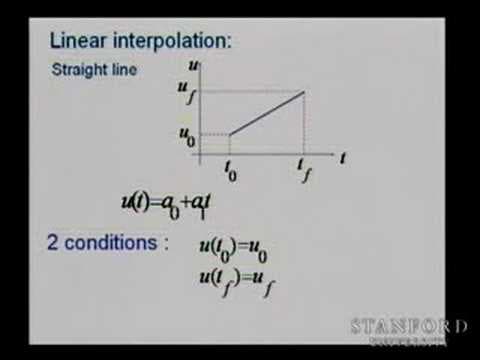
Lecture 10: Trajectory Generation (CS223A)
Krasimir Kolarov presents the principles and algorithms behind trajectory generation for robots. This lecture covers methods for planning smooth, efficient, and collision-free paths for robotic motion.
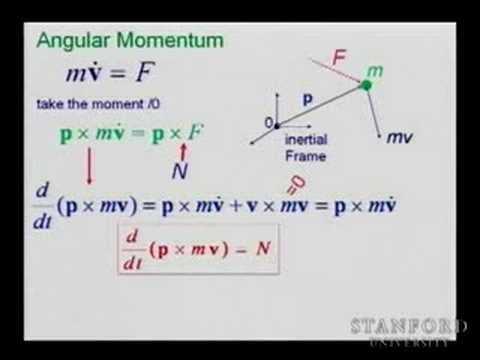
Lecture 11: Introduction to Dynamics (CS223A)
This lecture initiates the study of robot dynamics, focusing on the forces and torques that govern robot motion. It lays the groundwork for understanding how robots move under various loads and accelerations.
Lecture 12: Dynamics (CS223A)
Continuing the discussion on robot dynamics, this session further explores the mathematical models and principles describing robot motion in response to forces. Topics include the equations of motion and their application.
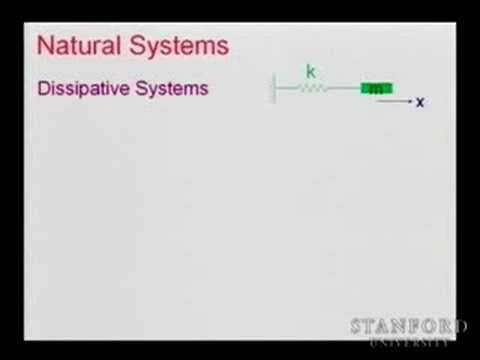
Lecture 13: Robotics Control (CS223A)
This lecture introduces the fundamental concepts of robotics control, examining methods to command and regulate robot behavior. It covers initial principles of feedback control systems for robotic applications.
Lecture 14: Robot Control and One Degree of Freedom Systems (CS223A)
This session advances the topic of robot control, specifically analyzing control strategies for one-degree-of-freedom systems. It details fundamental principles applicable to simpler robotic mechanisms.
Lecture 15: Control (CS223A)
Continuing the in-depth exploration of robot control, this lecture focuses on advanced techniques for precise manipulation and movement. It covers aspects of force and position control in complex robotic systems.
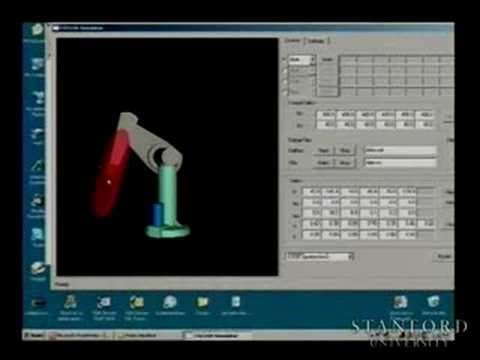
Lecture 16: Compliance (CS223A)
This final lecture examines the concept of compliance in robotics, focusing on how robots interact with environments by accommodating forces. It covers compliant motion, force control, and various robot types.