
1:23:43
Academic Discipline
Algorithms & Theory
Algorithms, data structures, computational complexity, cryptography, formal verification, logic, and type theory.
14courses86standalone talks359total lectures
Subfields
Cross-Disciplinary Bridges & Theoretical Foundations · Theory & Algos
6 connectionsStructural connections linking subfields, mathematical foundations, and courses across disciplines.
Applied Counterpartcourse
18.404J: Theory of Computation
MIT · Michael Sipser
This course is a foundational introduction to computational complexity theory, covering Turing machines, decidability, complexity classes (P, NP, PSPACE), and the P vs. NP problem, defining the core of the subfield.
Conceptual Bridgespeaker
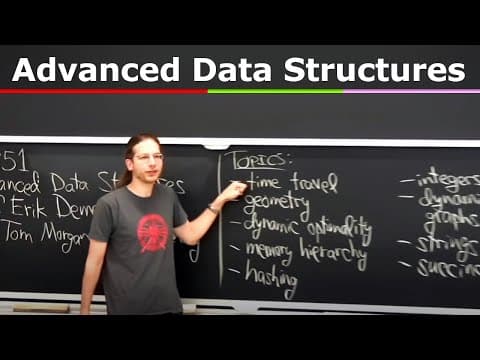
Erik Demaine
MIT · 47 lectures
Demaine's work on algorithmic lower bounds and hardness of approximation directly addresses fundamental questions within computational complexity theory.
Conceptual Bridgespeaker
Ryan O'Donnell
Carnegie Mellon University · 100 lectures
O'Donnell's research on analysis of Boolean functions and hardness of approximation directly contributes to the theoretical foundations of computational complexity.
Conceptual Bridgelecture
Arithmetic Geometry and Computation
Minhyong Kim · ICMS Edinburgh
Arithmetic geometry provides the deep mathematical foundations for modern cryptography, particularly elliptic curve cryptography, by leveraging properties of algebraic varieties over finite fields for secure key exchange and digital signatures.
Conceptual Bridgecourse
6.001: Structure and Interpretation of Computer Programs (SICP)
MIT · Hal Abelson & Gerald Jay Sussman
SICP's rigorous approach to program construction and reasoning, particularly its emphasis on referential transparency and formal semantics, naturally bridges to formal methods and type theory for program correctness.
Conceptual Bridgelecture
A Multiset Approach to Arithmetic (Mathematics Foundations 227)
Norman Wildberger · University of New South Wales
This lecture explores alternative foundational approaches to mathematics, specifically multiset theory, which offers a different perspective on cardinality and arithmetic compared to traditional set theory and category theory.

59:50

58:48

Systems & CS·Conference Talk·Algorithms & Data Structures · Stijn Vannieuwenhuyse · Domain-Driven Design Europe

32:31