Ian Ball
Professor · MIT
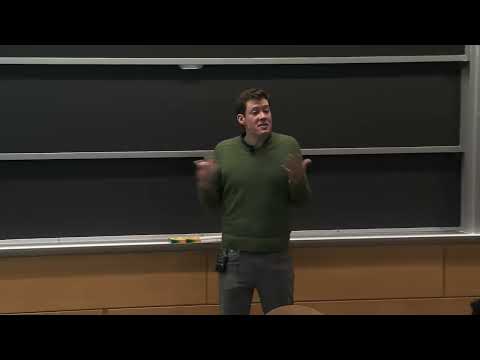
Ian Ball is a professor at MIT who teaches MIT 14.12, Economic Applications of Game Theory, an undergraduate course.
- lectures
- 25
- series
- 1
- hours
- 32
Start here


Series and courses
MIT 14.12: Economic Applications of Game Theory
Open the course
Show 21 moreShow fewer
- 5Nash Equilibrium
- 6Imperfect Competition
- 7Zero-Sum Games
- 8Backward Induction
- 9Negotiation
- 10Subgame-Perfect Nash Equilibrium
- 11One-Shot Deviation Principle and Bargaining
- 12Finitely Repeated Games
- 13Infinitely Repeated Games
- 14Folk Theorem
- 15Implicit Cartels
- 16Bayesian Games
- 17Bayesian Nash Equilibrium: Applications
- 18Auctions
- 19Revenue Equivalence
- 20Ad Auctions
- 21Perfect Bayesian Equilibrium
- 22Signaling
- 23Bargaining with Incomplete Information
- 24Cheap Talk
- 25Common Knowledge
In these lectures
- A strategy in a Bayesian game must be a complete contingent plan that specifies an action for every possible mental state or type a player might hold.Bayesian Nash Equilibrium: Applications
- Subgame-perfect Nash equilibrium extends backward induction to handle games of imperfect information and infinite games.Subgame-Perfect Nash Equilibrium
- Backward induction works by starting at the end of an extensive-form game tree and reasoning backwards to the beginning.Backward Induction
Draws on
People cited in the lectures, at the moment of the citation.
- John NashWon the Nobel Prize in Economics; published foundational papers introducing the Nash equilibrium concept in 1948-1949.
- Paul MilgromCited for the quote 'the game is always larger than you think'.
- Jean-Jacques Rousseau1600s philosopher credited with describing the Stag Hunt game.
- Roger MyersonNobel laureate, cited for 1991 definition of game theory
- Robert AumannNobel laureate, cited for 1989 definition of game theory as interactive decision theory
- Drew FudenbergMIT professor, formalized a version of the Folk Theorem in a 1986 paper.
Playlists
8


About
Ian Ball is a professor at MIT who teaches MIT 14.12, Economic Applications of Game Theory, an undergraduate course. Ball moves from dominance and Nash equilibrium through backward induction and repeated games to revenue equivalence and sponsored-search ad auctions.
Taught with
Same subject, Economics & Finance
Connections
28Their places, courses, books and lectures.
Institution1
Concept1
Lectures25
- Bayesian Nash Equilibrium: Applications
- Subgame-Perfect Nash Equilibrium
- Backward Induction
- Auctions
- Nash Equilibrium
- Implicit Cartels
Show 19 moreShow fewer
- Imperfect Competition
- Finitely Repeated Games
- Revenue Equivalence
- Introduction to Individual Decision-Making
- Infinitely Repeated Games
- Folk Theorem
- Negotiation
- Representation of Games
- Dominance
- One-Shot Deviation Principle and Bargaining
- Perfect Bayesian Equilibrium
- Zero-Sum Games
- Cheap Talk
- Ad Auctions
- Signaling
- Bayesian Games
- Rationalizability
- Bargaining with Incomplete Information
- Common Knowledge